
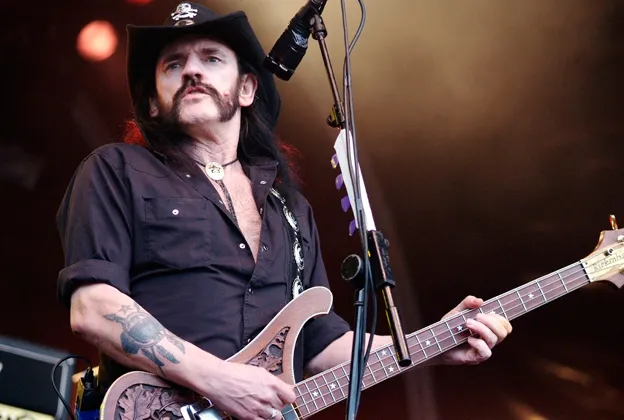
Ask most people who the greatest guitarist of the 1950s was, and they’ll say Chuck Berry. Lemmy Kilmister had a different answer. “Eddie Cochran — I never got to see him live, but he could play. Him and Buddy Holly, they were the best guitarists. They could get a good raunchy beat going.”
This wasn’t a casual opinion. It was the verdict of a man who began as a rhythm guitarist, absorbed the lessons of that era, and spent four decades building one of rock’s most unmistakable and powerful sounds on that very foundation.
And when Lemmy said raunchy, he meant something very specific: the one thing most guitarists never fully grasp — that feel always beats technique..
When Lemmy Kilmister had an opinion, he delivered it the same way Motörhead delivered music — loud, direct, and with no interest in telling you what you wanted to hear. So when the hard rock and heavy metal icon was asked to name the greatest guitarists of the 1950s, his answer surprised many. He didn’t reach for Chuck Berry, the man most historians call the founding father of rock. He didn’t mention Elvis Presley’s guitarist, Scotty Moore. Instead, Lemmy singled out two figures whose influence was raw, deep, and often overlooked: Eddie Cochran and Buddy Holly.
“Eddie Cochran — I never got to see him live, but he could play. Him and Buddy Holly, they were the best guitarists. They could get a good raunchy beat going,” Lemmy said. That word — raunchy — is key. He wasn’t talking about technical skill or theory. He was talking about feel: the raw, instinctive, dangerous quality that separates players who move people from those who merely impress them.
Understanding why Lemmy’s opinion matters requires knowing who he was before he became Lemmy. Long before the Rickenbacker bass, the mutton chops, and the wall of Marshalls, Ian Fraser Kilmister was a sixteen-year-old in Liverpool who saw the Beatles play at the Cavern Club, picked up a six-string guitar, and learned licks from their debut album Please Please Me. He was a rhythm guitarist first, and that early experience shaped everything he later did on bass. When he joined Hawkwind with no prior bass experience, he developed a style that emphasized chords and double stops, a direct inheritance from his rhythm-guitar roots.
Lemmy’s perspective on 1950s guitar wasn’t that of a casual listener. He had learned from those players, absorbed their feel, and built one of rock’s most instantly recognizable sounds on top of that foundation.
Eddie Cochran, born in Oklahoma in 1938 and raised in California, embodied the raw potential of early rock and roll. With his Gretsch 6120 and Fender tweed amps, he pushed his sound into overdrive effortlessly. He wrote and often produced his own songs, played multiple instruments, and pioneered studio techniques like multitracking and overdubbing years ahead of his time. Tracks like Summertime Blues, C’mon Everybody, and Somethin’ Else remain some of the most thrilling guitar recordings ever laid to tape. Cochran even influenced British guitarists — session player Big Jim Sullivan credited him with teaching them how to get the “American string-bending sound” by replacing the standard third string with a lighter second string.
Despite his innovation, Cochran’s commercial success in the U.S. was modest. He never placed more than one single in the Billboard Top 10. His legend grew tragically after his death at 21 in a taxi accident in England in 1960, just four years into a brief but extraordinary career.
Buddy Holly, born Charles Hardin Holley in Lubbock, Texas in 1936, operated on a similar plane. He fused blues, rock and roll, and country in a form the industry could broadcast on television. His open-chord strumming on 1957’s Peggy Sue embodied the “I can do that!” spirit of early rock, inspiring countless bands — including the Beatles, whose very name was a nod to Holly’s Crickets. Holly died at 22 in the same plane crash that claimed Ritchie Valens and The Big Bopper, immortalized by Don McLean as “the day the music died.”
For Lemmy, Cochran and Holly represented a specific, irreplaceable quality: rhythm, drive, and the ability to make a song feel alive and dangerous from the first downstroke. This principle — that power comes from commitment, not complexity — became the backbone of Motörhead’s music.
Interestingly, Lemmy did revere Chuck Berry. At Berry’s Rock and Roll Hall of Fame tribute, he praised the guitarist as “a seminal figure in rock and roll… a great lyricist and poet… one of the cornerstones.” But when it came to raw 1950s guitar playing, Lemmy’s heart belonged to Cochran and Holly.
Lemmy’s admiration for the founding generation never faded. “Rock and roll sounded like music from another planet,” he said, recalling the first wave: Elvis, Little Richard, Chuck Berry, Jerry Lee Lewis. Motörhead’s music amplified the speed and volume, but the DNA remained the same: two chords, maximum attitude, and a beat that could not be ignored.
His other ultimate guitar hero, Jimi Hendrix, existed in a category of his own. “The fucking best,” Lemmy said. Van Halen and others didn’t come close. He learned from Hendrix while working as a roadie for the Jimi Hendrix Experience, absorbing lessons in performance and showmanship. But Hendrix was a natural force; Cochran and Holly were the architects of the vocabulary Hendrix would later build upon.
Lemmy Kilmister passed away on December 28, 2015, four days after his 70th birthday. He left behind one of rock history’s most uncompromising legacies. And within every overdriven chord, every locomotive rhythm, you can still hear the echo of two young men from Oklahoma and Texas who figured out how to make a guitar sound like the end of the world.