
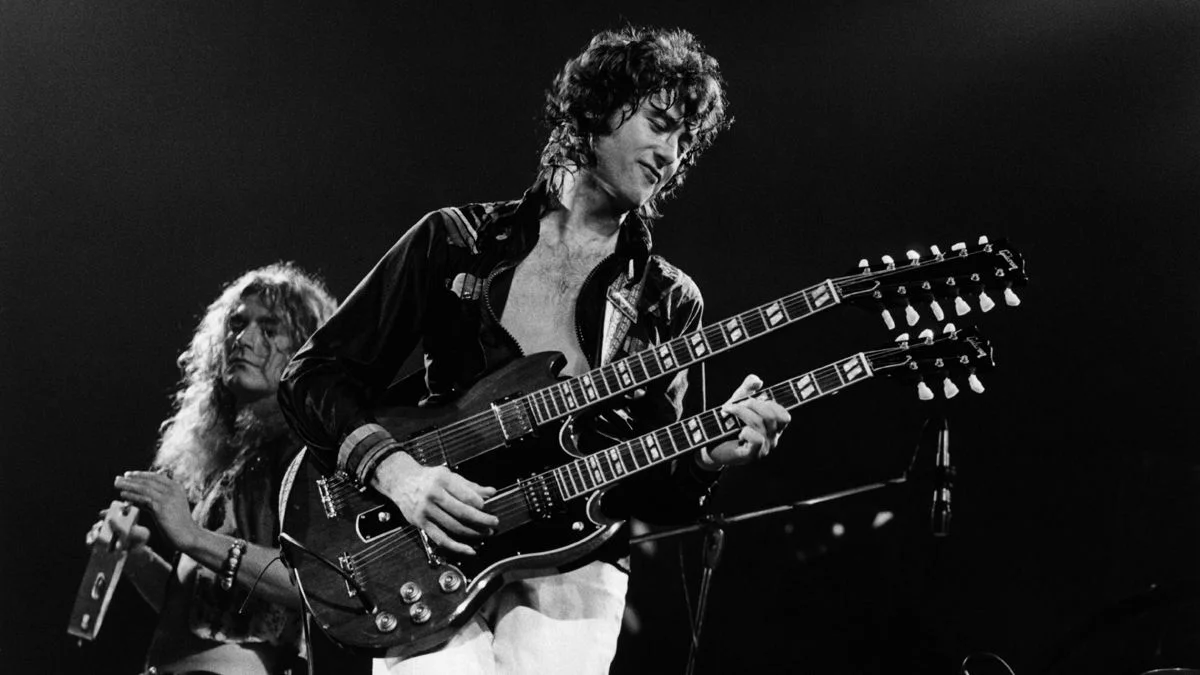
Jimmy Page originally envisioned Ten Years Gone as an instrumental. He felt the music was so melancholy that words might only get in the way. Then Robert Plant heard it — and reached back a decade into his own life, recalling a woman who had forced him to choose between her and his music — and wrote lyrics that left Page speechless.
Plant told Rolling Stone in 1975: “She’s got a washing machine that works by itself and a little sports car. We wouldn’t have anything to say anymore. Ten years gone, I’m afraid.”
This week, Page released the original home demo — the version that existed before a single word was sung. Fourteen guitar tracks. No vocals. No lyrics. Just the raw, haunting sound of something magnificent before it knew its own story..
Nobody announced it. No press release. No teaser campaign. Jimmy Page simply uploaded a home demo to his YouTube channel — a recording of a song he’d crafted alone at Plumpton Place long before it became one of Led Zeppelin’s most emotionally devastating tracks. The song was Ten Years Gone. The demo had never been heard publicly before, and the story behind it — a love ultimatum, a choice that changed everything, and a decade of reflection that became music — is one of rock’s great untold origin stories.
Page introduced the demo himself: “As a footnote to Physical Graffiti, I thought you might like to hear the original home demo, recorded in my studio at Plumpton Place, of a piece that was going to surface as Ten Years Gone. I presented this rough mix to the band at Headley Grange to develop it properly. Robert Plant came up with some extraordinary lyrics, and that’s how the song became what it is.”
“Extraordinary” is telling — the word of a man who has spent his entire life surrounded by exceptional music and still found something that stopped him in his tracks. To understand why, you have to go back to before Led Zeppelin existed.
Before Robert Plant became rock’s golden god — before sold-out arenas, myth-making, and albums that redefined electric music — he was a young man in the English Midlands, scraping for gigs, working tirelessly, and deeply in love with a woman who gave him an ultimatum: her or the music. “I was working my ass off before joining Zeppelin,” Plant told Rolling Stone in 1975. “A lady I really dearly loved said, ‘It’s me or your fans.’ Not that I had any fans, but I said, ‘I can’t stop, I’ve got to keep going.’”
He chose music. The relationship ended. And for ten years, as Led Zeppelin conquered the world, the memory of that choice lingered quietly. By the time Physical Graffiti was recorded, Plant reflected on what had become of that woman: “She’s quite content these days, I imagine. She’s got a washing machine that works by itself and a little sports car. We wouldn’t have anything to say anymore. I could probably relate to her, but she couldn’t relate to me. I’d be smiling too much. Ten years gone, I’m afraid.” That bittersweet reflection became the emotional DNA of the song.
Page had originally intended Ten Years Gone as an instrumental. To build its layered harmonic structure, he recorded fourteen separate guitar tracks — a staggering feat for a home demo. The piece was inherently melancholy, so much so that Page initially felt words weren’t necessary. Then Plant heard it, and everything changed. He pulled from his own past and added lyrics that transformed the instrumental into one of Led Zeppelin’s most quietly devastating love songs.
Producer Rick Rubin described the finished track as “a deep, reflective piece with hypnotic, interweaving riffs — light and dark, shadow and glare. It sounds like nature coming through the speakers.” Unlike Whole Lotta Love, it doesn’t demand attention; it earns it slowly, and then it won’t let go.
The song has become a favorite of Page’s and an influence cited by artists including Slash, Tesla, and Gov’t Mule. Playing it live was another challenge: the fourteen guitar tracks could not be reproduced by a single guitarist. John Paul Jones handled a custom Manson triple-neck guitar — a six-string, twelve-string, mandolin, and bass pedal all in one — before the song was eventually dropped from the tour setlist.
This is not the first time Page has opened his archive for fans. In 2023, he released a previously unheard demo of The Rain Song, titled The Seasons, marking the 50th anniversary of Houses of the Holy. These releases reveal his careful, generous approach to Led Zeppelin’s legacy: letting listeners hear songs in their raw, original state.
The home demo of Ten Years Gone offers something rare: the sound of a masterpiece before it knew what it was about. Page alone, layering guitars, creating something melancholy, cinematic, searching. He didn’t yet know that Plant would fill it with one of rock’s most quietly devastating love stories. Fifty years later, hearing it unfinished, it still resonates with the same haunting power.