
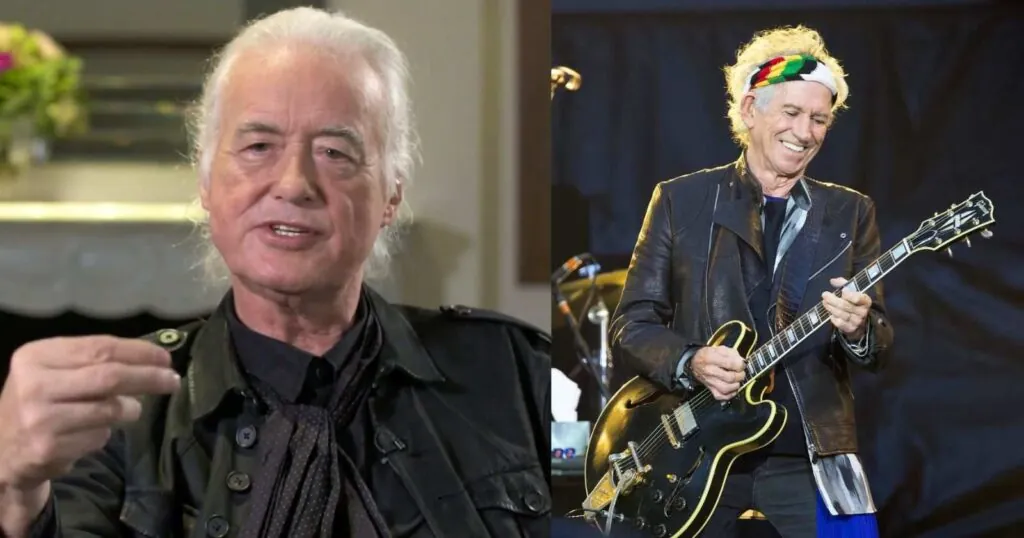
Rock history is full of legendary rivalries, mutual respect, and the occasional playful jab. One of the most entertaining exchanges in classic rock lore involves Keith Richards, Led Zeppelin, and the ever-unflappable Jimmy Page—a moment that perfectly captures the clash between two titans of rock and roll philosophy.
“Too Loud”: The Keith Richards Take
Keith Richards has never been shy about his opinions on modern (or even not-so-modern) rock acts. Known for his raw, blues-rooted approach with the Rolling Stones, Richards has often favored groove, swing, and feel over sheer volume and bombast.
At one point, Richards reportedly brushed off Led Zeppelin’s sound as being “too loud.” It wasn’t just a technical critique—it reflected a deeper aesthetic divide.
To Richards, rock and roll should breathe. It should roll, swagger, and sit in the pocket. Zeppelin, on the other hand, represented something far more explosive: towering riffs, thunderous drums, and a wall of sound that practically shook venues apart.
Led Zeppelin: Built to Be Loud
Led Zeppelin didn’t just play loud—they built a sonic identity around intensity. Jimmy Page’s production style embraced dynamics, contrast, and sheer power. When the band hit full stride, it wasn’t subtle—it was seismic.
From “Whole Lotta Love” to “Immigrant Song,” Led Zeppelin turned volume into an instrument of its own. For fans, that intensity wasn’t a flaw—it was the point.
So when criticism about being “too loud” surfaced, it wasn’t exactly new territory for the band.
Jimmy Page’s Priceless Response
When asked about critiques like Richards’, Jimmy Page’s response was simple, sharp, and quietly confident. Rather than arguing or dismissing the comment, Page essentially leaned into Led Zeppelin’s identity.
The essence of his reply boiled down to this: that was the whole idea.
Page never tried to compete with the Stones on their terms. Instead, he helped build a different kind of rock experience—bigger, heavier, and more immersive. In his world, volume wasn’t excess—it was expression.
And that’s what made his response so memorable. No defensiveness. No backlash. Just quiet assurance that Led Zeppelin knew exactly what they were doing.
Two Visions of Rock
This exchange highlights one of the most fascinating dynamics in rock history:
The Rolling Stones: groove, blues roots, swing, and understatement
Led Zeppelin: power, mystique, sonic dominance, and grandeur
Neither approach is “correct.” They simply represent different philosophies of what rock music can be.
And that’s why both bands didn’t just survive the era—they defined it.
Why This Moment Still Matters
Decades later, this story still resonates because it’s more than just a quote exchange. It’s a snapshot of a creative tension that pushed rock music forward.
Without artists like Keith Richards pushing for feel and restraint, and artists like Jimmy Page embracing volume and ambition, rock might never have developed its full range.
In the end, “too loud” wasn’t an insult—it was a compliment in disguise. It meant Led Zeppelin had pushed past the expected boundaries.
And Jimmy Page’s response? It didn’t just defend the band. It defined it.