
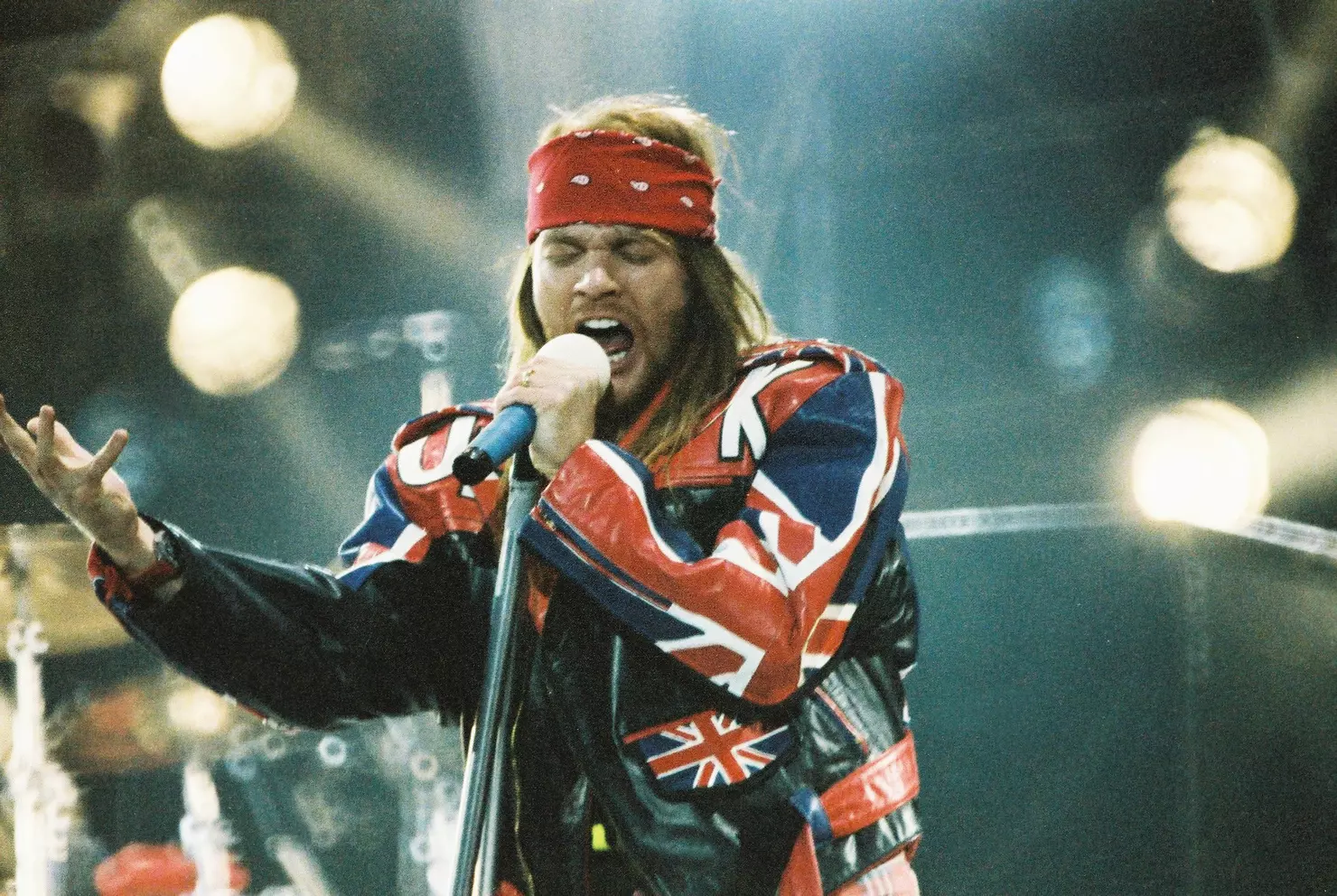
For decades, Axl Rose’s ferocious scream has reverberated through stadiums, establishing itself as one of rock’s most iconic battle cries. As the frontman of Guns N’ Roses, he became synonymous with chaos, rebellion, and raw emotional power. But behind the swagger, the leather jacket, and the bandana lies a childhood story far darker than many fans ever realized—a history that explains why his voice often sounded less like a performance and more like an emotional release.
Born William Bruce Rose Jr., Axl spent much of his early life under an identity that was, for years, incomplete. His biological father left when he was very young, and his mother remarried a man named Stephen Bailey. For much of his youth, Axl lived under the surname Bailey, unaware of the full truth surrounding his biological father and the circumstances of his early life. It wasn’t until Axl was 17 that he discovered crucial details about his true parentage.
That revelation was not just a minor detail—it was seismic. To learn that your name, your lineage, and your entire origin story had been partially hidden could fracture a person’s sense of self. Axl has described his upbringing as suffocating, with strict rules and an atmosphere of rigid control. His household felt authoritarian, leaving him little room for self-expression. Music, in that context, became his escape.
In interviews over the years, Axl has opened up about enduring severe discipline and emotional turmoil during his youth. The combination of psychological strain and identity confusion created a deep well of anger that had no safe outlet. For a teenager grappling with a shattered sense of trust and unresolved trauma, there were few ways to channel those emotions. When Axl left Indiana for Los Angeles, he carried that emotional weight with him.
What emerged in Hollywood wasn’t just a singer—it was a persona forged in confrontation. The volcanic energy in songs like “Welcome to the Jungle” wasn’t an act created for shock value. The snarl, the wail, the explosive stage presence—they were deeply personal expressions of a soul in turmoil. The chaos in his voice mirrored the chaos of his past.
To audiences in the late 1980s, Axl’s rage felt revolutionary. He wasn’t polished—he was raw. While other rock stars cultivated a cool detachment, Axl exploded with raw emotion, as though detonating in real time. That authenticity, however chaotic, became Guns N’ Roses’ trademark. “Welcome to the Jungle” pulses with a sense of paranoia and survival, with lyrics that feel less like storytelling and more like a personal testimony.
Axl’s stage performances often bordered on catharsis. He would run across the stage, scream until veins bulged, and confront cameras with barely contained intensity. These weren’t just rock theatrics; for Axl, the stage became a space of reclamation. The child who had once felt powerless in a controlled and repressive home could now command tens of thousands with a single note.
Understanding this context redefines the myth around his temper and unpredictability. The anger that critics sometimes dismissed as arrogance or instability was, in many ways, a delayed emotional reaction. It was the sound of someone processing years of confusion, isolation, and pain—amplified for all to hear.
Though Axl has evolved over time, the emotional core of his early years remains embedded in his music. The identity he ultimately chose—Axl Rose—was more than just a stage name. It was an act of reclamation. After uncovering truths that unsettled his sense of self, he rebuilt his identity on his own terms.
The scream that defined a generation did more than sell records. It told the story of survival, reinvention, and the complex journey from a childhood marked by control to a life lived loudly, defiantly, and unmistakably on his own terms.
https://www.facebook.com/photo/?fbid=852901197786937&set=a.162924676784596