
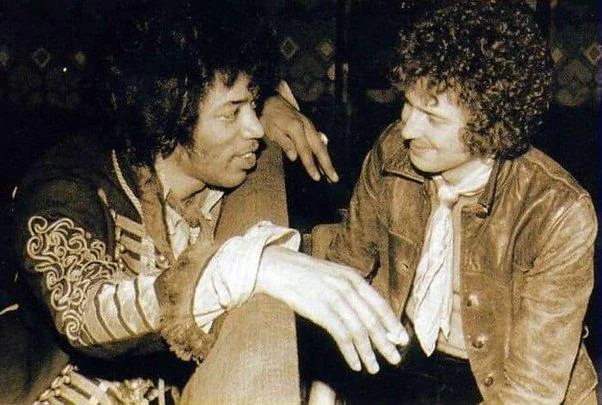
In the world of rock history, there are moments that are documented in photos, recorded on tape, and replayed endlessly. And then there are moments that live somewhere in between fact and myth—passed down through stories, whispered in interviews, and debated by fans for decades.
One of the most famous of these is the night Jimi Hendrix and Eric Clapton reportedly shared a stage in London—and then never really spoke about it afterward.
A Collision of Two Guitar Worlds
In the late 1960s, London was the beating heart of a musical revolution. Blues had evolved into electric rock, and guitar heroes were emerging like mythological figures.
On one side stood Eric Clapton, already revered in Britain for his work with The Yardbirds and Cream. His tone was controlled, expressive, and rooted deeply in the blues tradition.
On the other side was Jimi Hendrix, a newcomer to the UK scene who quickly redefined what the electric guitar could do—wild, explosive, unpredictable, and otherworldly.
When Hendrix arrived in London in 1966, the music scene didn’t just notice him—it was shaken by him. And Clapton, one of the most respected guitarists of the time, was among those who took notice immediately.
The Jam That Became a Legend
Accounts from musicians and audience members suggest that Hendrix and Clapton did, in fact, end up playing together informally at various clubs and backstage sessions in London during Hendrix’s early UK years.
One of the most repeated stories involves a surprise moment on stage where Hendrix joined Cream or crossed paths with Clapton during a live jam. Clapton, known for his disciplined playing, was reportedly caught off guard—not by lack of skill, but by Hendrix’s sheer unpredictability.
Hendrix, meanwhile, was said to treat these encounters less like “performances” and more like musical experiments—stretching harmonies, bending rhythm, and pushing the guitar into sonic chaos while still staying deeply musical.
Whether it was a single night or multiple brief jams, the legend grew because almost no official recording exists, and neither guitarist spent much time documenting it publicly.
Why They Rarely Talked About It
What makes the story even more mysterious is what came after.
Both Hendrix and Clapton were famously reserved—though in very different ways. Clapton often reflected deeply on his influences and struggles, while Hendrix tended to avoid over-explaining his art altogether, preferring the music to speak for itself.
Some fans believe the silence comes from mutual respect: there was no need to analyze something so instinctive and fleeting. Others suggest the moment was so intense, so improvisational, that it resisted being pinned down into words.
And then there’s the simplest explanation: in a time when music was evolving at lightning speed, these kinds of encounters may have felt less like “historic events” and more like just another night in London.
Two Styles, One Shared Language
What makes the idea of Hendrix and Clapton playing together so compelling is not just the rarity of it—but how different they were.
Clapton’s playing is often described as structured emotion—phrasing built on blues tradition, restraint, and tone control.
Hendrix’s approach was liberation—feedback, distortion, and harmonic exploration used as expressive tools rather than limitations.
Yet beneath those differences was a shared foundation: the blues. That common language made any meeting between them not just possible, but explosive in its potential.
The Myth Lives On
Whether the “silent jam” happened exactly as told, or has been reshaped by decades of retelling, it remains one of rock’s most fascinating legends.
What’s undeniable is this: when two of the greatest guitarists in history occupied the same space and time, even briefly, something unforgettable likely happened—even if it was never properly recorded, and even if neither man ever felt the need to explain it afterward.