
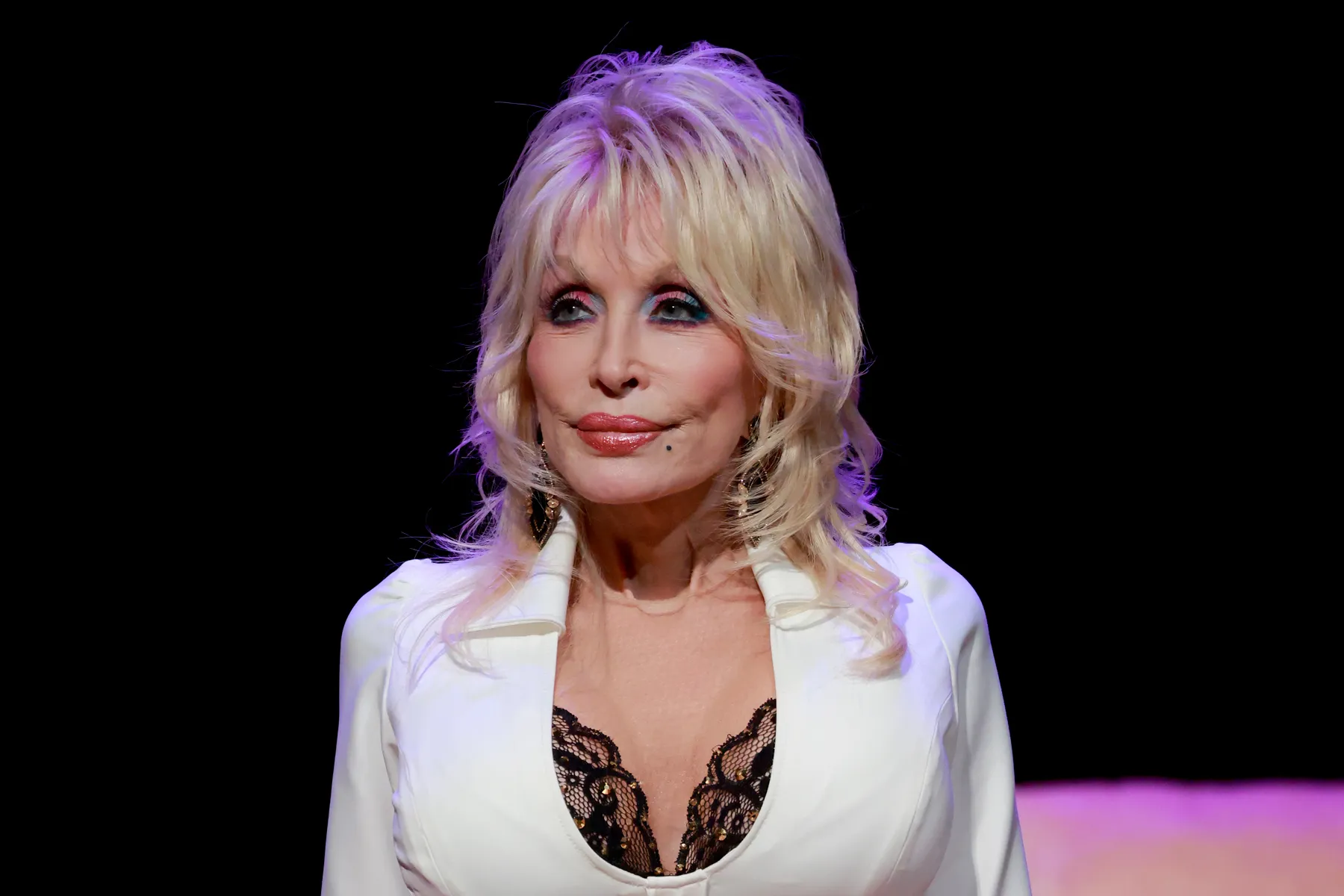
For generations, society has treated motherhood as the ultimate measure of a woman’s fulfillment. Few women have faced this expectation more persistently than Dolly Parton. Married for decades to Carl Dean, raised in a large family with twelve siblings, and celebrated for her warmth and generosity, Parton was repeatedly asked the same intrusive question: Why didn’t you have children?
Her answer never wavered—and it never apologized.
Dolly Parton made a conscious decision not to have children in the traditional sense, not out of regret or inability, but out of clarity. She understood early on that her calling was expansive. “Since I had no kids, I had freedom,” she explained, noting that the absence of domestic responsibilities allowed her to work tirelessly, tour globally, write constantly, and build an empire that reached far beyond the confines of a single household. For Parton, fulfillment was never about biology—it was about influence.
Instead of internalizing judgment, she reframed it. She often described her childlessness as a kind of divine assignment, famously saying she believed she wasn’t meant to have children so “everybody’s kids could be mine.” This wasn’t just a metaphor—it became a guiding philosophy for her life and work.
This belief found its most powerful expression through the Imagination Library, the literacy program she founded in 1995 in honor of her father, who grew up poor and never learned to read. What started as a small, local initiative blossomed into one of the most influential literacy programs in modern history. By 2026, the Imagination Library had distributed over 300 million books to children worldwide, sending age-appropriate books directly to their homes from birth until age five.
The scale is staggering. Millions of books are sent each month across the United States, Canada, the United Kingdom, Australia, and Ireland. For many children, these books are the first they’ve ever owned—often arriving with the child’s name printed on the envelope, a subtle but profound affirmation that they matter.
Parton’s decision not to have children didn’t limit her legacy; it amplified it. Free from the expectations that demanded she shrink her ambitions, she went on to produce more than 50 studio albums, write over 3,000 songs, earn 11 Grammy Awards, and build one of the most respected philanthropic records in entertainment. Her impact spans music, education, disaster relief, and public health—most notably her early financial support for COVID-19 vaccine research.
Dolly Parton’s life stands as a direct challenge to the notion that womanhood has only one acceptable shape. By refusing to define her worth through motherhood, she redefined motherhood itself—not as possession, but as care; not as lineage, but as legacy. She didn’t give birth to children, but she gave millions the tools to imagine a future. And in doing so, she chose the world.
https://www.facebook.com/photo/?fbid=830190120052343&set=a.167472762990752