
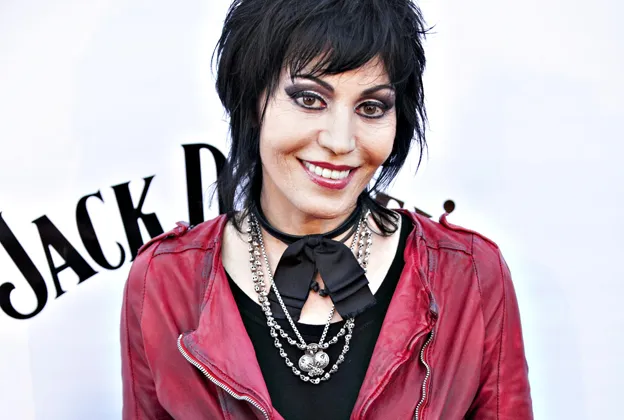
In a powerful conversation on the Music Makes Us podcast — hosted by punk icon Kathleen Hanna — legendary rocker Joan Jett spoke candidly about the role of music and musicians in today’s turbulent world. Her message is simple, but profound: music isn’t just entertainment — it’s a way we make sense of the world and speak to each other, especially during difficult times.
Jett’s perspective matters because she’s not just a singer — she’s someone who’s lived through decades of cultural shifts, resistance, and change. From pioneering punk rock with The Runaways and Joan Jett & the Blackhearts, to becoming a symbol of resilience, she’s seen firsthand how music can shape social moments.
📢 Music as Commentary — Not Just Performance
During the podcast, Jett was asked whether music still influences how people engage with the world. Her answer? Absolutely. And she pointed to a clear example: Bad Bunny’s 2026 Super Bowl halftime show.
Bad Bunny — a global superstar and Puerto Rican artist — made history as the first solo Latino headliner of the Super Bowl LX halftime show, performing a set nearly entirely in Spanish. This was significant not just for representation, but for cultural identity — especially at a time when racial, political, and immigration issues are being passionately debated in the United States.
According to cultural reporters, critics, and historians, his performance was interpreted as a political and cultural statement — even though he didn’t explicitly broadcast a political message in English. By choosing Spanish and highlighting themes tied to identity and pride, Bad Bunny showed how music itself can become a form of political expression — simply by existing in spaces where people traditionally expect something else.
What made this even more meaningful was the backlash from political figures before the performance even took place. Some U.S. politicians criticized the show and questioned the choice of a Spanish-language set, even vowing opposition — which turned into a massive global conversation once the show aired.
In fact, Bad Bunny’s performance drew one of the largest global audiences ever for a Super Bowl halftime show, with billions of views across broadcast and social platforms, according to world press reports — a sign that music can create cultural moments well beyond national boundaries.
🎤 Jett’s Message: Musicians Have a Voice — and They Should Use It
Jett’s own journey shows why she believes music matters. On the podcast, she recalled touring internationally with her band, and how everywhere they went, people asked about the political and social climate back home. “People want to know what’s happening in your country,” she said, pointing out that when artists have a platform, they can choose to use it thoughtfully.
She made it clear she doesn’t think every musician needs to become a political activist — nor should they spend all their time debating politics — but she does believe musicians can offer a few “well-thought-out sentences” that acknowledge the world around them. Art, she said, has always done more than simply entertain.
She concluded by rejecting the idea that artists should “shut up and sing” — a phrase that has been used to tell performers to stay out of social issues. Jett said that’s never really been the role of artists. From folk singers who marched for rights in the 1960s, to punks who screamed against inequality, music has always been part of social commentary.
🎶 Why This Matters Now
In 2026, the world is facing major sociopolitical challenges — from immigration debates and cultural fights in the U.S., to global tensions and social media divides. Jett’s call reflects a larger conversation: people want truth, connection, and meaning, and music helps provide those things. It’s not just about catchy hooks or big stadium shows — it’s about how music reflects who we are as people.
Bad Bunny’s Super Bowl moment — controversial to some, inspiring to others — is a perfect example. Through art and culture, he invited millions to see Latin culture at the center of one of the world’s biggest broadcasts. Jett, with decades of rock ’n’ roll behind her, reminded us that art and meaning are inseparable.
In a divided world, music isn’t neutral — but that’s part of its power. It can heal, challenge, question, inspire, unite, and yes, even spark change. And Joan Jett says that’s something we should celebrate — not silence.