
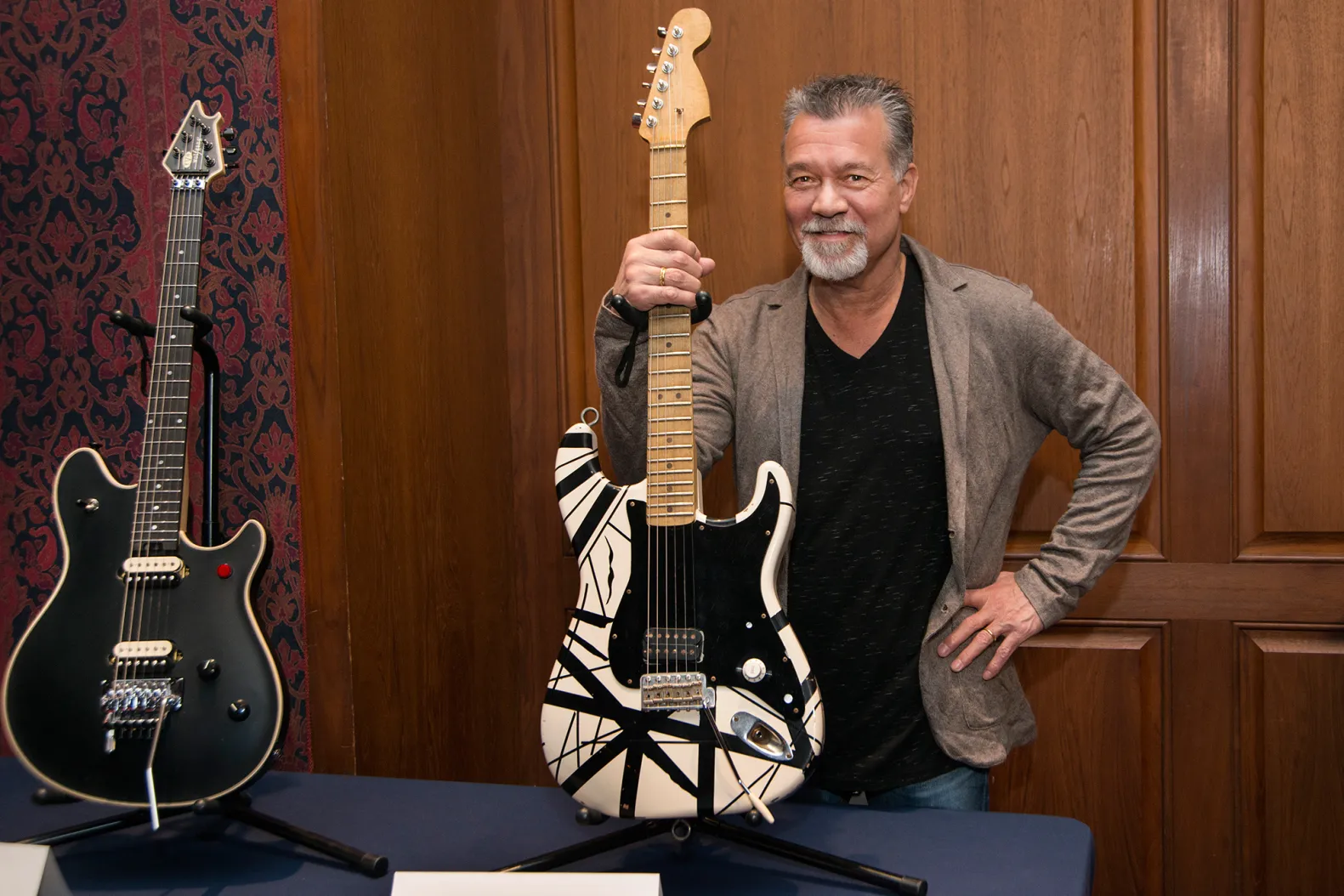
Eddie Van Halen is often remembered as one of the greatest guitar players of all time. Many people focus on how fast he could play, how groundbreaking his tapping technique was, or how solos like “Eruption” completely changed rock guitar forever. But Eddie’s true greatness wasn’t just about speed or difficulty. At his core, Eddie believed that music should always serve the song and connect emotionally with the listener.
When Eddie was growing up, rock and roll was still finding its identity. Bands from the British Invasion, like The Dave Clark Five, played a huge role in shaping early rock music, but guitar playing at that time wasn’t extremely technical. Things began to change when players like Eric Clapton and Jimi Hendrix arrived. They treated the guitar as more than just a rhythm instrument. They pushed it to its limits and explored new sounds, new tones, and new emotions.
Eddie was deeply inspired by these musicians. He studied their playing closely, not to copy them exactly, but to understand how they expressed feeling through their instruments. Even though Eddie later became famous for advanced techniques like tapping and harmonics, he never wanted to be a show-off. His goal was never to play as many notes as possible. His goal was to make the music feel right.
A great example of this mindset can be heard when Eddie played the guitar solo on Michael Jackson’s “Beat It.” The solo is exciting and memorable, but it doesn’t overpower the song. Eddie made sure his playing added energy without taking attention away from the music itself. For him, the song always came first.
This idea becomes even more interesting when looking at the rise of grunge music in the early 1990s. Bands like Nirvana focused less on technical skill and more on raw emotion. Kurt Cobain wasn’t interested in complex solos. He wanted his music to sound honest, emotional, and real. Some people thought this meant grunge was a rejection of guitar heroes like Eddie Van Halen, but that wasn’t entirely true.
Eddie actually shared a similar belief. Long before grunge existed, he admired musicians who played from the heart rather than worrying about perfection. One of his biggest inspirations was Neil Young. Young’s guitar playing was often messy, loud, and imperfect — but it was full of emotion.
Eddie once said that one of his favorite guitar solos was from Neil Young’s song “Cinnamon Girl.” The solo is extremely simple. It uses only one note played over and over again. Yet, it fits the song perfectly. Eddie believed that no flashy or complicated solo could replace what Neil Young did in that moment. It worked because it felt right.
This appreciation shows that Eddie understood something many players miss: music doesn’t need to be difficult to be powerful. While guitarists like Yngwie Malmsteen amazed listeners with speed and precision, Neil Young proved that emotion alone could leave a lasting impact. Eddie respected both approaches and managed to balance them better than almost anyone else.
In the end, Eddie Van Halen’s legacy is not just about technical brilliance. It’s about understanding when to hold back, when to push forward, and when to let feeling lead the way. He showed the world that a great guitar player isn’t defined by how many notes they can play, but by how deeply they can connect with the music.