
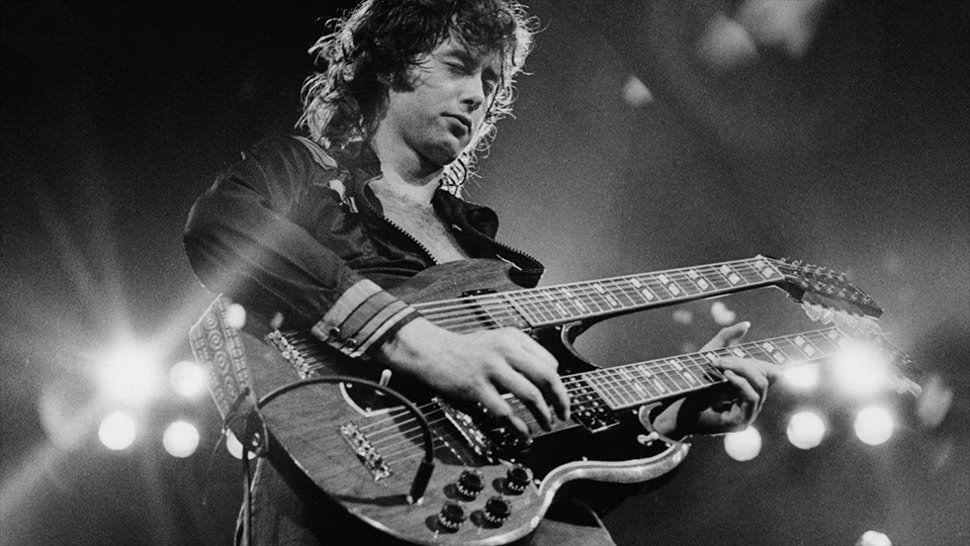
“He may not know that”, When Jimmy Page admits there’s a song even Neil Young might struggle with, you know it’s legendary. Some riffs are just next-level…
Jimmy Page is often ranked as one of the greatest guitarists in rock history. As the guitarist of Led Zeppelin, his riffs, solos, and guitar tones helped shape hard rock and heavy metal. Still, some listeners have noticed something surprising when they listen closely to his guitar parts on their own. Instead of clean, perfectly separated notes, there are moments where Page hits strings he did not mean to hit or briefly touches notes in between frets while moving along the neck. To some people, this sounds like mistakes.
At first, this can feel shocking. How could a guitarist from one of the most respected bands ever sound “messy”? But understanding Jimmy Page’s style helps explain why this happened and why it actually worked so well for Led Zeppelin.
Jimmy Page did not play like a modern, highly polished guitarist who focuses on perfect technique at all times. His roots were in blues, early rock and roll, and live performance. Before Led Zeppelin, he worked as a session musician, playing on many recordings in the 1960s. This gave him experience, but it also shaped his approach. He learned how to create mood, energy, and excitement rather than focusing only on technical perfection.
When you hear Page’s playing in isolation, some notes blend together or sound rough. In a technical sense, these could be called flaws. However, when those same parts are heard inside the full band mix, they often sound powerful and emotional. His guitar fills the space between Robert Plant’s vocals, John Paul Jones’s bass lines, and John Bonham’s heavy drums. Together, these elements create the famous Led Zeppelin sound.
It is also important to look at the rest of the band. Robert Plant was usually very accurate with his vocal notes. John Paul Jones and John Bonham were known for being tight and disciplined musicians, even when playing complex rhythms. Page, on the other hand, brought chaos, fire, and unpredictability. That contrast is one reason the band sounded so exciting. His playing did not need to be perfect because it added character and emotion.
Even though Page’s style could sound unpolished, his guitar tone was instantly recognizable. Songs like “Whole Lotta Love,” “Black Dog,” and “Stairway to Heaven” would not be the same without his unique sound. Many guitarists can play the right notes, but very few can create a tone and feel that people recognize within seconds. Page could do that.
This uniqueness also made his parts hard to copy. Even great musicians sometimes needed help understanding exactly how Page played certain songs. A good example is when Led Zeppelin reunited for their Rock and Roll Hall of Fame induction and invited Neil Young to play with them. Neil Young is an excellent guitarist with a legendary career of his own. Still, Page was unsure if Young could quickly learn some of Zeppelin’s more complex songs.
Page later explained that Young wanted to play a Led Zeppelin song rather than a cover. Page worried that a song like “Black Dog” might be difficult to pick up on short notice, not because Young lacked skill, but because Page’s parts were unusual and not always straightforward. In the end, they chose “When the Levee Breaks,” a song with a heavy blues feel that suited Young’s style better.
This story shows that Jimmy Page’s guitar work was not simple or standard. Even when it sounded loose, it had its own logic and feel. That feel is very hard to teach or copy.
So, was Jimmy Page sloppy? In a technical sense, sometimes yes. But rock music is not only about perfection. It is about emotion, energy, and identity. Page’s small mistakes, rough edges, and wild moments helped bring Led Zeppelin’s music to life. Without them, the songs might have been cleaner—but they would not have been as memorable.