
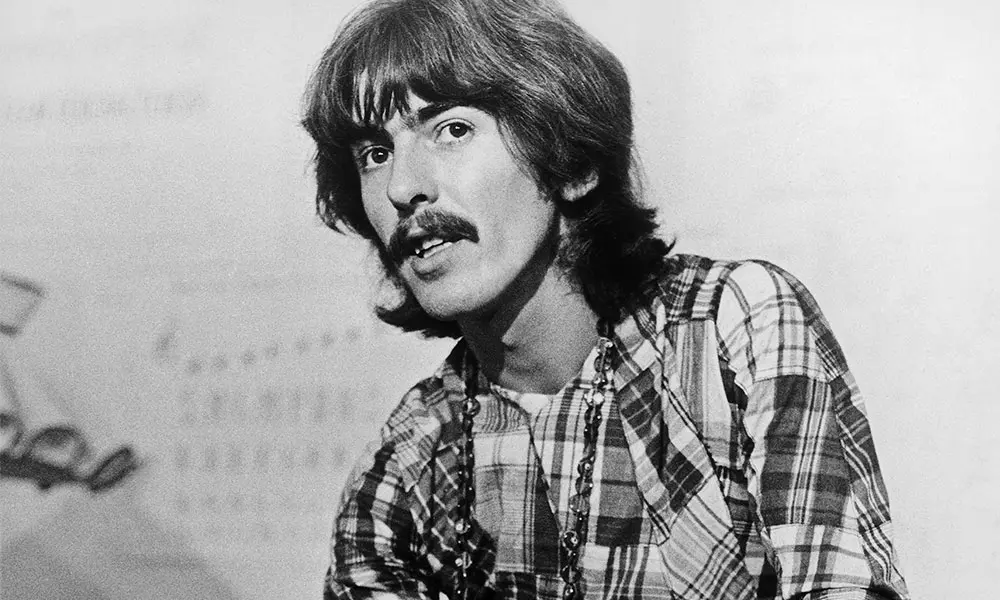
Even as their career drew to a close and personal tensions pulled them in different directions, The Beatles continued to push boundaries and defy expectations. This spirit of innovation—so deeply embedded in their legacy of transforming music—was particularly evident in ‘Because’, a standout track from 1969’s Abbey Road. While the song is memorable for many reasons, it was George Harrison who gave it its most revolutionary feature.
Opening with the atmospheric pattern of the harpsichord, played by producer George Martin, and featuring the exquisite, otherwordly vocal harmonies of John Lennon, Paul McCartney and Harrison, the song floats like smoke into the air and envelops the listener. While drummer Ringo Starr doesn’t even feature on the song, apart from providing hand claps as the guide track in the studio, there is no doubt that ‘Because’ is one of the finest and most affecting moments of the group’s last chapter.
While much of this tumultuous period in The Beatles’ history remains clouded by conflicting narratives—inevitably shaped by the growing divide within the band—one certainty is that the inspiration for ‘Because’ stemmed from Lennon’s wife, Yoko Ono. An avant-garde artist and accomplished pianist, Ono was playing Beethoven’s iconic ‘Moonlight Sonata’ one day as Lennon reclined on the sofa, lost in thought about the state of the world. The sound of the familiar melody caught his attention, setting the creative wheels in motion.
Offering a clear picture of his immense creativity, he asked her to play the chords backwards, which gave him the melodic foundation of ‘Because’. The final product would bear some similarities to Beethoven’s original, feature flecks of Lennon and Ono’s fruitful creative partnership at the time, as well as a strong hit of psychedelia, even if it is lacking wailing guitars, bass and drums. It’s a transcendental moment that is augmented by somewhat incomprehensible lyrics such as: “Love is old, love is new / Love is all, love is you”.
Although you’d expect a band with so much innovation behind them to be running out of ideas by this stage, The Beatles proved otherwise—this is precisely what sets them apart from everyone else. To achieve the sonic resplendence of the song, which is centred on the layering of the trio’s voices, they sang together and then overdubbed their vocals twice. This technique creates the illusion of a chorus of nine singers, resulting in a rich, otherworldly harmony that elevates the track.
However, the most game-changing aspect of the track occurred when the vocals and the rest of the instrumentation were completed on August 5th, 1969. This saw Harrison tape the bubbling Moog synthesiser part over the recording. This was the first time the instrument would feature on Abbey Road before later being used on ‘Maxwell’s Silver Hammer’, ‘I Want You (She’s So Heavy)’ and ‘Here Comes The Sun’. This revolutionised the album and confirmed that the Fab Four were still at the forefront of music by using the novel invention.
Harrison was always interested in learning new instruments, as his grasp of 26 recorded instruments shows. So, when he heard about the early Moog model, the 3-series, he had it shipped from California to his home in Esher and then to Room 43 at Abbey Road Studios when he had mastered it.
Despite describing it as “a foreboding black object the size of a bookcase, littered with dozens of knobs, switches, and patch cords”, it would transform the direction of The Beatles. They weren’t done yet.