
For fans who have traced every twist in the Beatles story this latest look at the band’s final live performances offers clarity on what actually counts as the end of the Beatles on stage. There are two important but very different events in Beatles history that often get mixed up when people talk about the band’s last concert.
One was the last paying concert in front of an audience and the other was the last time the four Beatles played together in public. Both carry emotional weight for fans and have been explored through music lore and archival releases in recent years.
The final commercial concert that many fans still hold nostalgia for took place at Candlestick Park in San Francisco on August 29 1966. It was the closing show of the Beatles most recent North American tour and the band knew they were done with touring. They had already been struggling with the limits of live performances overshadowed by screaming crowds hearing little of the music.
This Candlestick Park show was part of a long summer tour through the United States and Canada that had included major cities and huge audiences. The band’s setlist that night reflected their earlier era of hit singles. Paul McCartney sang lead on “Long Tall Sally” the high-energy Little Richard cover they had often used to close their concerts
 .
.
Contrary to some of the more sentimental social media interpretations this concert was not a reunion or magical finale in the romantic sense. There was no onstage reflection about endings or band emotions in that moment.
For the Beatles themselves it was simply the conclusion of their touring life and a pragmatic decision to focus on studio creativity. After returning to England the band would spend the next few years exploring studio innovations that culminated in revolutionary albums such as Sergeant Pepper’s Lonely Hearts Club Band and The Beatles.
However the story of the Beatles’ “last concert” does not end there. Many historians and fans point to a different event almost three years later.
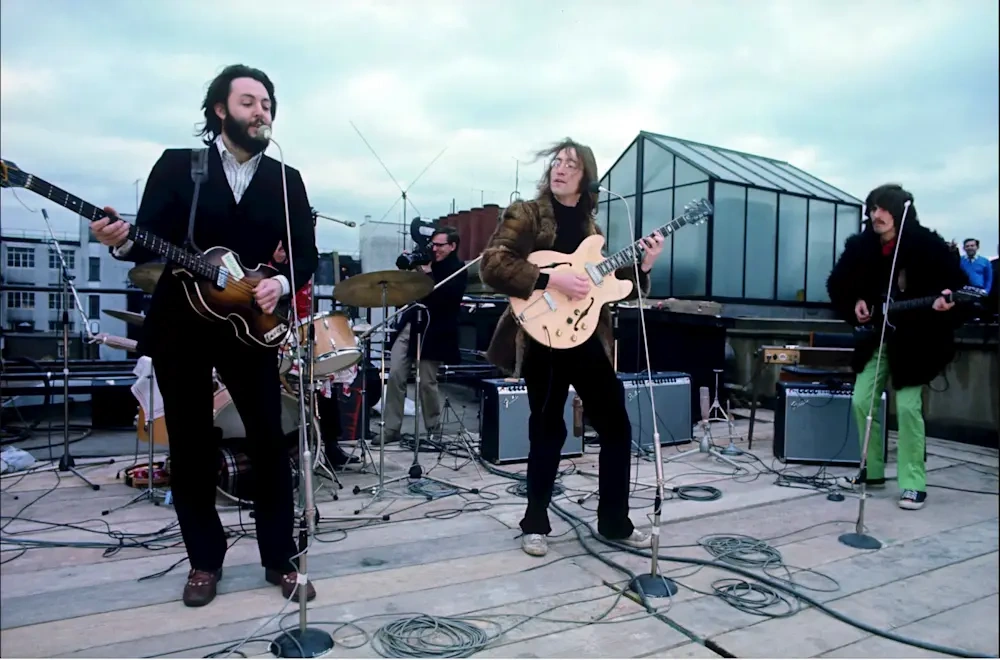
On January 30 1969 the Beatles performed an impromptu rooftop concert on the Apple Corps headquarters building in London.
It was not part of a tour or a formal ticketed event. It was a surprise set during the sessions for what would become the Let It Be project.
The band played for about 42 minutes before London authorities asked them to turn down the volume. They performed several songs including multiple takes of “Get Back” and moments of “Don’t Let Me Down” and “I’ve Got a Feeling” before the police ended the performance.
Many fans consider this the true last Beatles live performance because it was the last time all four members John Lennon Paul McCartney George Harrison and Ringo Starr played together in public.
It carries a more poignant emotional resonance because it came during the band’s final months together and was captured on film in the Let It Be documentary.
In that footage Paul McCartney jokes after the final song as the crowd applauds “I’d like to say thank you on behalf of the group and ourselves and I hope we’ve passed the audition” a line that feels both celebratory and bittersweet given how soon their partnership would dissolve.
The rooftop show was later restored and released as part of the larger Beatles Get Back documentary and audio recordings from the performance have been officially issued to streaming platforms in recent years.

That has only deepened fan interest in the event and highlighted its place in Beatles lore. For some listeners the raw sound and unplanned feeling of that rooftop set is a more meaningful ending than a stadium show from 1966.
Beyond these two historically documented events there are social memories and mythic versions of Beatles performances circulating online. Some posts on social platforms have described the rooftop gig as a miracle reunion or suggested emotional personal reunions that left Paul McCartney in tears and hinted at spiritual significance. Those narrative elements are characteristic of passionate fan storytelling. They reflect how closely listeners attach personal meaning to these moments but they are not supported as factual events by credible documentation.
For Beatles fans the dual identity of the “last concert” is part of what makes the band’s transition from touring act to studio innovators so fascinating.
The 1966 Candlestick Park show marks the end of their commercial live career and the 1969 rooftop performance marks the last time the four men would play publicly as a group. Each has its own emotional truth and historical importance and both continue to resonate with listeners around the world more than half a century later.